
Tug of Trap
A room-wide team battle built with Vite, TypeScript, and PixiJS. Viewers choose blue or red, build pulling power together, and use gifts to protect their team or disrupt the other side.
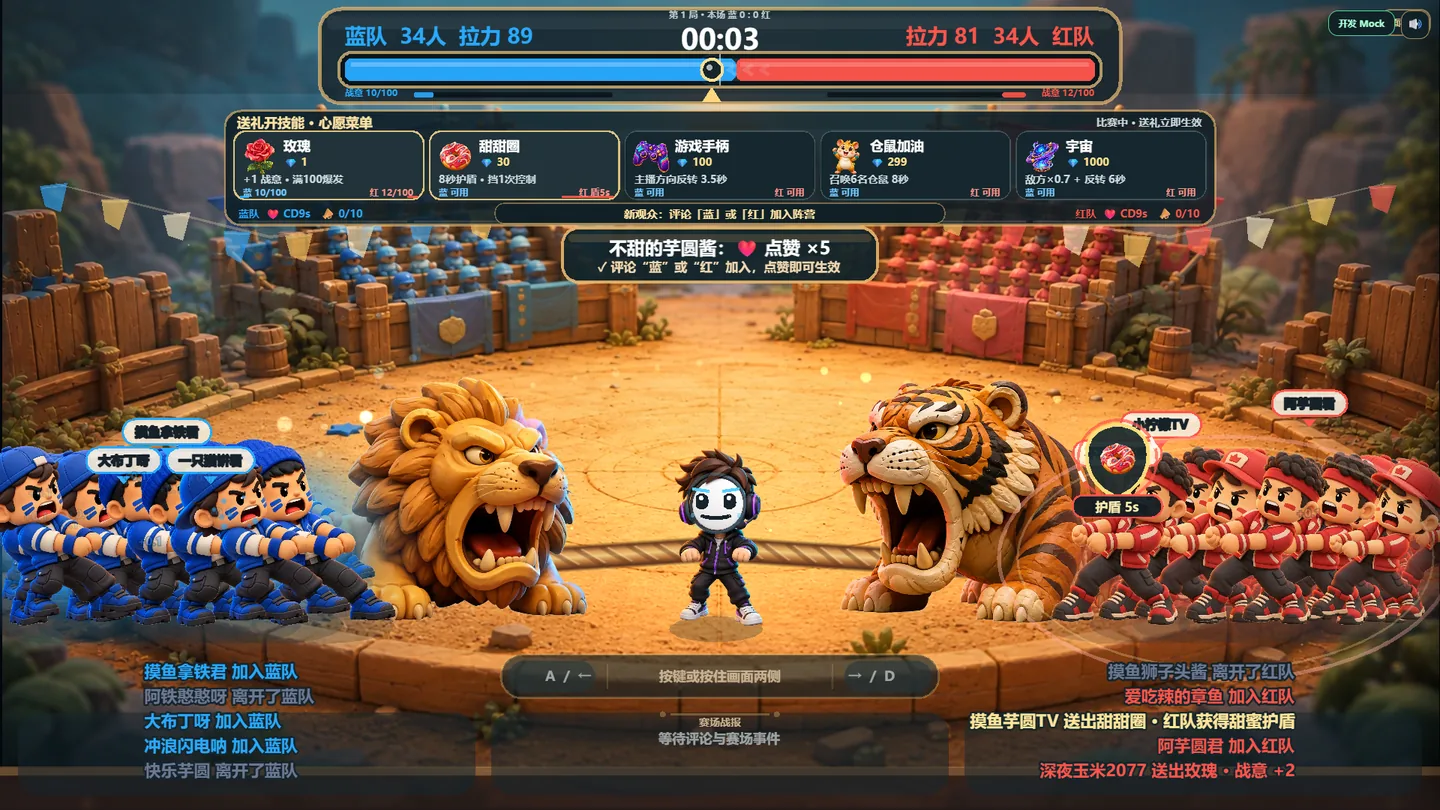
FORMATTeam competition
STACKPixiJS + TypeScript
PUBLIC EVENTSLike · Gift · Chat
DELIVERYLocal WebSocket
From event stream to tug-of-war
| Event | Game mapping | Stability rule |
|---|---|---|
live.chat | Select a team; recognized cheers build team actions | Team is locked for the current round; chat commands have cooldowns |
live.like | Strengthens the viewer's unit; each 100-like milestone launches a team wave | Uses cumulative milestones instead of one effect per raw message |
live.gift | Triggers a named tactical skill for the selected team | Matches gift.id, handles combo deltas, and queues pre-round gifts |
Gift design
| Gift ID | Gift | Effect |
|---|---|---|
5655 | Rose | +1 team morale |
5879 | Doughnut | Shield for 8 seconds; blocks one controller reversal |
7569 | Game Controller | Reverses creator controls for 3.5 seconds |
17358 | Hamster | Adds six visible helpers for 8 seconds |
11046 | Universe | Reduces opposing pull to 70% and reverses controls for 6 seconds |
Gifts received before a viewer chooses a team wait briefly for ownership; unresolved gifts join the smaller real-player team. Effects are capped, cooled down, or converted to morale instead of stacking without limit.
How it was built
- Prove the game loop. A deterministic tug simulation established team force, rope position, round states, and victory before live data was connected.
- Add the protocol boundary. Port discovery,
SERVER_HELLOvalidation, authentication, heartbeat, deduplication, and reconnection were isolated from the PixiJS scene. - Turn events into fair rules. Team selection, like milestones, cheer windows, gift ownership, combo handling, and cross-round queues were added as testable domain logic.
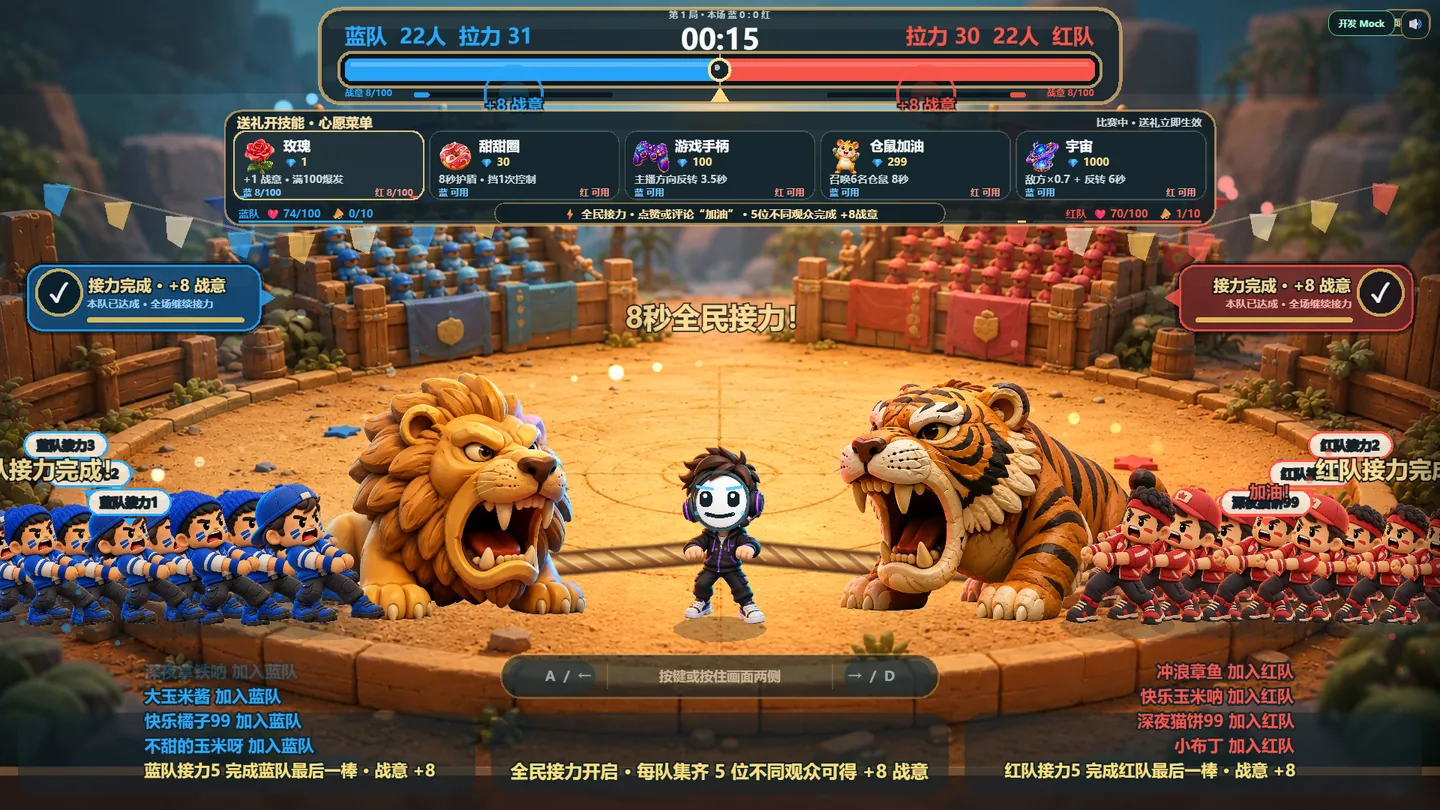
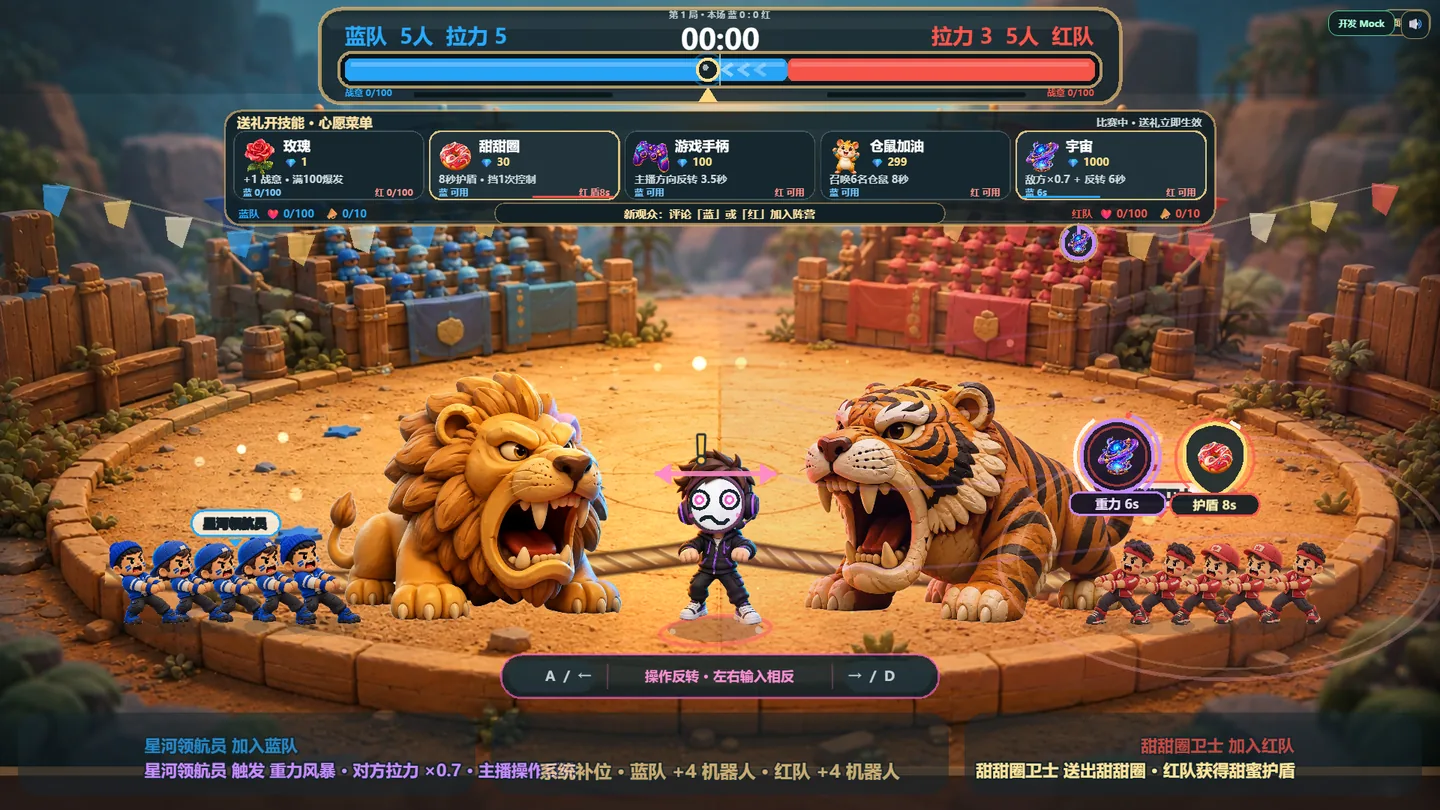
- Raise presentation quality. The flat prototype evolved into a 3D toy-diorama style with readable blue/red states, character reactions, gift VFX, MVP, streaks, and result choreography.
- Create a public path.
?demo=1uses clearly labeled simulated interactions; the real mode continues to require LIVE Studio and in-memory credentials.
Gameplay states
Engineering takeaways
- The browser never assumes a fixed port; it discovers
127.0.0.1:49152-65535and validates the hello before authenticating. - Credentials stay in memory. Public demo mode does not ask for or persist them.
- The event adapter produces domain commands. Rendering code never parses raw protocol payloads.
- Bounded queues, cooldowns, deduplication, and round cleanup prevent event bursts from corrupting the match.
- The public deployment contains the playable build; the development repository can remain private.
Next: inspect the event contracts or apply for access.